Tuesday, December 13, 2011

Bach/ Biber/ Tartini: Max Rostal et al., 1957


I've been trying to explore classical music lately, mostly small combo pieces and music for strings. I've been having trouble consistently finding things that I like because the genre is deep in a way that's so foreign to me. I haven't figured out how to spot the albums I like because so many of the great composers and performers were so prolific. Until you listen to a record, you have no idea how it will sound unless you know the composition ahead of time. If anyone has any recommendations based on the clip below, please let me know.

This week's album contains pieces by three composers: Sonata in E Minor by Johann Sebastian Bach, Passacaglia by H.I.F. von Biber, and Concerto in G Minor by Giuseppe Tartini. Listening to Bach's sonata was something of a breakthrough for me because it was the first time I ever enjoyed the harpsichord. I usually think its sound is less refined and expressive than other instruments', and it doesn't help that the volume and timbre of each note are fixed regardless of how hard you hit the keys. When a harpsichord is high in the mix it's in your face for the whole song. In the sonata, the harpsichord and the cello lay down a foundation for the violin and the rich tones of the harpsichord blend into the background smoothly. The violin part is very striking and the harpsichord and cello create a lush texture throughout the song.

Max Rostal, violin on Passacaglia
Max Rostal , violin; Frank Pelleg, Harpsichord; Antonio Tusa, Cello on Sonata
Max Rostal, violin; Winterthur Symphony Orchestra, Walter Goehr, conductor on Concerto

Sonata in E Minor 1st movement by Easy Jams

Tuesday, December 6, 2011

Brasil Maior Vol 1: Various Artists, 1980


This might be the first compilation on the blog. It's a collection of Brazilian music that's not 100% essential listening, but it includes some really nice tracks, especially on the second side. My favorite is Ela Desatinou, written by Chico Buarque and performed by Nara Leão. The song was originally released in 1980 on Leão's album Com Açúcar, Com Afeto. In the middle of the 70's, she had left the music world altogether to focus on her family and study psychology. She had already started recording again when she learned that she had inoperable brain cancer in 1979, and in the subsequent 10 years before her death she was incredibly prolific.

The beauty of this song caught my attention right away, and when I learned that she recorded it a year after receiving her diagnosis, I was inspired. It was not the strength of her spirit in the face of death so much as the way that she was able to take control of her creative impulse and produce not only an incredible quantity of music, but a song this beautiful to top it off. I don't have much more to say than that Leão is a beautiful example of the endless creative potential that people possess. It's amazing to witness the incredible feats, artistic and otherwise, that great people manage.

Ela Desatinou by Easy Jams

Wednesday, November 23, 2011

Thelonious Monk: Epistrophy, 1980


My introduction to the jazz aesthetic was Misterioso, one of Monk's live albums recorded during sessions at New York's Five Spot in the 50's. Very few albums have had as great an effect on my music appreciation as that one, and it continues to touch me in a way that few albums can. Misterioso will always be my favorite, but I love how Monk's other recordings document the way that he continued to modify his compositions and sound over the course of his career. In addition to his contribution to the jazz sound itself, Monk also became a masterful exponent of the jazz practice of producing infinite variations on musical themes.

This recording captures a Paris appearance by Monk's quartet in 1970. Monk gives every note a lot of weight by playing with a rare sparseness, especially on Sweet and Lovely, which takes up the entire A side. Every member of the band leaves plenty of room for the others, giving the performance a more delicate quality than other Monk recordings. I know nothing about Affinity, the Spanish label that released this album first, but the recording was made by BYG people and the sound quality is very clear. Personally, I would go so far as to rank this album among Monk's classic recordings, but that distinction is usually reserved for major label releases.

Crepescule with Nellie by Easy Jams

Wednesday, November 16, 2011

Pandit Samta Prasad: Tabla Recital, 1974


This one comes from the Gramophone Company of India Limited, an EMI subsidiary, and although there is violin and tanpura accompaniment, the focus in unquestionably Prasad's tabla playing. He has a very intricate style, establishing patterns and then quickly moving on to other ones. Prasad comes out of the Benares gharana, achieved significant recognition for his skills in his lifetime and had a relatively prolific recording career. On this album he played the first side in tritaal, or tintal, the 16 beat cycle, and the second in roopaktal, the 7 beat cycle.

Since Prasad plays in the Benares style, I became curious about how he compared to the other great Benares tabla player I've heard, Lachchu Maharaj. As soon as I saw Maharaj playing tabla on this video, I was struck by the way that his rhythmic genius appealed to a jazz standard of beauty. http://youtu.be/C_70fUJJXfY?t=1m28s Prasad's music has a different kind of rough elegance. Unlike some performers who only hit the drum heads with sharp, definitive strikes, Prasad is not afraid to use the sound of his palm brushing against the skin of the tabla.

While both of these men were educated in versions of the Benares gharana (apparently the gharana's true style is disputed) Maharaj also studied under a variety of masters from all different parts of India and created a unique style by combining techniques. There are considerable differences between the playing on the Maharaj video and the Prasad album, but the performance contexts were also very different. Prasad's was a formal studio recording session and Maharaj's an intimate concert in which he could let his personality shine through a little bit more. I have no idea about the relationship between these two men if there ever was one, but both of them play remarkably different music with similar levels of creativity. Plus both recordings feature the tabla as the solo instrument. I'd be interested to hear more Benares tabla if anyone has any recommendations.

Tritaal by Easy Jams

Tuesday, November 8, 2011

Tico All-Stars: Descargas Vol. 3, 1966


This is the third and last Descargas album, part of a live recording of a concert organized by New York salsa DJ Symphony Sid that featured many of the great Tico Records musicians. The concert went on for hours, and this volume captures songs from late in the night, when the band was deep into the jams. The sound quality is less than perfect, probably because there were so many musicians and not a lot of time to set up the mics, but the music has an energy that cuts through the roughness of the recording.

On the back cover, Tico president Morris Levy included a note of thanks to the DJ. Levy would go on to lead a much-criticized career in the music industry. He ventured into jazz and rock, famously engaged in a series of lawsuits with John Lennon and a few major labels, and died after being convicted of extortion. It was not Levy's career specifically that interested me so much as the breadth of the music that he managed to involve himself in. It got me thinking about the way that music fans go about finding music.

People interested in exploring the world of recorded music learn to dig for new recordings by chasing what I call threads. These threads can be almost anything: they are typically musicians, but they can include producers, arrangers, recording engineers, labels, genres, countries of origin, record cover aesthetics, and so on. Morris Levy's career is a perfect example of how erratically these threads can zigzag and connect in unexpected ways, visibly intersecting on records.

Sometimes these threads lead us astray and frustrate us; just today, I picked out what I thought was a samba record to find that it was closer to disco. Just as often, it is also the unpredictable pathways of these threads that make the hunt for new music magical, because they lead us through oblique channels to amazing recordings that we could have otherwise missed. The more threads we follow, the more we realize the vastness of the entire body of recorded music and how impossible it is to listen to more than an insignificant fraction of it. At the same time, though, we also get a sense of the interconnection between artists and genres that we would consider unrelated if we didn't know better.

Saxes: Alfred Abreu and Robert Porcelli
Trumpets: Pedro Boulong, Vincent Frisaura, Victor Paz, Alfredo Armenteros
Trombones: Jose Rodrigues, Barry Rogers
Flute: Johnny Pacheco
Piano: Eddie Palmieri, Richard Maldonado, Charlie Palmieri
Bass: Bobby Rodriguez, Israel Lopez
Congas: Joe Cuba, Candido Camero, Ray Barretto
Timbales: Tito Puente, Jimmy Sabater
Vibes: Tito Puente
Cow bell: Chino Pozo, John Rodriguez
Bongo: John Rodriguez
Vocals: Santos Colon, Rafael Davila, Jose Feliciano, Ramon Sardiñas

Descarga Pompo by Easy Jams

Tuesday, November 1, 2011

George Pang and Friends: At Skateland Live, 1984


This album is available elsewhere but I'm posting it because I have a pretty clean copy and because I wanted to use it as a jumping off point for a follow up article to the occupy piece I wrote last week. This album features a number of famous and lesser known dancehall singers freestyling over drum and bass beats supplied by producer George Pang, who sampled them from Sly and Robbie. The lyrics cover everything from social issues to love to the dangers of smoking. As is the case with a lot of dancehall, some of the lyrics of homophobic and mysogynist, but Lady Ann also sings a song about how hard it is for female DJs to make it in the face of the prejudice that characterizes the male-dominated music industry. On the opening track, Buro Banton sings about all the politicians and foreigners who smuggle guns to poor Jamaicans. He says that although the politicians consider the Soviets enemies, these politicians have done more harm to the community than the Soviets, who never sent a single gun to the Jamaican ghetto. By inciting violence through the sale of guns, powerful outsiders continue to influence Jamaican society even as Jamaicans try to take back their identities and their lives by embracing rastafarianism and its doctrine of non-violence and detachment from Western materialism. Internal fighting holds everyone back and makes life in black Jamaica more difficult.

On the surface, this topic seems to have little to do with the occupy movement. Where Buro laments that powerful outsiders are turning poor Jamaicans against each other and therefore themselves, the occupants fear that they are being completely excluded from important decisions that affect all members of society equally. One group wants less contact with power altogether while the other desires a greater role in it. But one thing that sets the occupy protests apart from countless other American protests is the fraught role of police in the movement. As usual, the police are vilified for excessive and unnecessary use of force, (the response to the incidents in Oakland is a prime example of this,) but many protesters have also been reaching out to cops, or at least expressing solidarity with them, on the grounds that they too belong to the 99%. These protesters believe that the cops who use violence to suppress the occupants have been trained by the 1% to act contrary to their self-interest and the interests of their peers. This critique is very similar Buro's.

The trend of considering cops allies rather than foes, if it becomes a major feature of the occupy ideology, will distinguish these protests dramatically from most radical protests of the last half century. In the protests of the 60's, clashes with the police were more than a part of the movement; eruptions of violence became the symbolic staging ground for the two Americas to prove their allegiance to their ideologies. The police at that time did more than enforce order, they represented the order that the protesters sought to overthrow, and their violence against the protesters demonstrated how very entrenched that order was. In more recent protest movements, clashes with the police have tended to eclipse the issues that inspired the protests in the first place. I believe that the protesters will significantly empower themselves if they reappropriate the meaning of police, characterizing employment by the police department as a marker of working class identity rather than alliance with the state project. I'm sure such a semantic shift will be hard to orchestrate, not least because many cops will probably not go along with it, but if it can be done, I think it will help the movement achieve a new level of credibility in the eyes of many critics.

Buro by Easy Jams

Wednesday, October 26, 2011

Charlie Haden and the role of media sharing in occupy


First of all, I rarely put up posts with no album, but I just checked amazon and this one seems pretty easy to find on CD. (NB: if you want to buy it from amazon, please support a private vendor. Although amazon struck a deal with California to avoid a proposition battle over the California sales tax issue, they are still not bound by the law that they agreed to until September.) This might be the wrong time to start observing intellectual property laws given this post's sympathetic stance towards protesters who have been labelled anti-capitalist, but whatever. The album is Duets, recorded in 1976. Each of the four tracks features a different guest: Keith Jarrett, Alice Coltrane, Ornette Coleman and Paul Motian. I found Alice Coltrane's track the most musically inspiring along with Ornette's, but the album is definitely for committed jazz fans only. The song I want to talk about today is "For a Free Portugal," which features Haden on bass and Motian on percussion accompanied by two prerecorded tapes. The first captures Charlie dedicating a song to the Africans struggling for liberation from Portugal during a concert in Lisbon. The crowd roars in response. The second is a tape made in Angola by the Liberation Support Movement, included on the album with the group's permission. The tape features the group's anthem and field recorded war sounds. Hearing Haden incorporate this raw media into his album reminded me of the way that today's protesters share and borrow media like protest videos and add their own voices through commentary, editing choices, and other techniques.

The internet has unquestionably become a major tool for social and political change. It has featured prominently in the many Arab Spring movements and is playing a similar role in the occupy movement in the United States. Today more than any day so far I've noticed the viral spread of youtube videos featuring raw footage less than 24 hours old from occupy sites across the country. There is something very democratizing about high levels of access to technology, especially when this technology enables us to share media expressing and concerning the public's grievances. The images and recordings now circulating depict specific people and events, and yet like the public spaces that American protesters are occupying, they are both ownerless and at the service of the people. I think that this kind of media sharing demonstrates solidarity and support because it allows people to identify with the exact same sounds and images and to make these media their own. These sounds and images become points where people's aspirations and frustrations intersect and grow. The translocal connection that they engender can transform the act of occupying one city block into the act of occupying a bureaucracy or an ideology. The world is going to keep getting smaller, and as it does, I think that expressions of solidarity through media sharing will become more widespread, meaningful, and effective.

Some general thoughts on occupy: Fortunately, it seems like modern protesters recognize the limits of the purely internet-based activism that overloaded our inboxes throughout the late 90's and most of the 2000's before Facebook became the main venue for that sort of thing. People today understand that the internet can enhance real world movements but that the act of being there is still important. In fact, being there can be even more effective when "there" is a translocal, even transnational space.

Of course, no movement has the support of all the people. Occupy has taken a lot of heat for its lack of clarity on a concrete agenda and for the presence of participants who many Americans do not consider serious political actors. To me, the movement looks more like a group of people who have indisputably liberal tendencies but who became fed up for their own reasons. These protesters essentially share one thing: the suspicion that if the people with the most power are becoming richer than ever and most others are becoming poorer than they have been in a long time, there are probably better solutions to the problems facing our nation than the ones we are using at the moment. Unlike the Tea Party, which has sought change by entrenching itself in the bureaucracy, the occupy protesters seem to believe that a more immediate strategy is both necessary and more likely to work.

As a final note on the power of grassroots-mediated images, I want to acknowledge the sympathetic skeptics of the internet who try to prevent us from getting carried away with our own rhetoric, like the people who brought us this picture:


I struggle with the Western tendency to flatten representations of Africa into representations of poverty and "underdevelopment", but images like this also help keep things in perspective.

Tuesday, October 25, 2011

Ruth Busbee: Blessed Assurance, 1981


Another gospel album here, this time from singer Ruth Busbee. As you've probably noticed, I tend to focus on instrumental music, and even when I include music with a vocal component, the singing isn't always the highlight. The opposite is the case with this album. Although Busbee has a tight band and a strong choir backing her up, there is no question that she steals the show. She has a rare combination of range, technique and passion that are obvious right off the bat with the opening of section of Blessed Assurance, where she solos over the harmony before the groove drops.

I don't think it's a coincidence that I overlook a lot of gospel music on this blog; my focus on instrumental music has everything to do with it because gospel music is centered around the voice. As Reverend Jim Holley of the Rock Baptist Church, where the album was recorded, says on the back cover, "once in a lifetime, a voice comes full of life, pulsating, vibrant, and soulfully picturesque through the universe, expressing the universal... With every note expressed, you can feel the love of God [Ruth] has, and the love God has for Ruth." Part of what I think the reverend is getting at here is that any instrument in a gospel band can express the feeling of God, but only a singer can express the feeling and the message at the same time. Not to mention that we can pick up on emotional inflections more easily from a voice; with instrumental music, we have to use more subjective criteria to pick out emotional coloring.

Another thing about the back cover caught my attention is an uncredited quote that a google search suggests was paraphrased from the Bhagavad Gita. "Nothing in life is ours alone. What is yours today was someone else's yesterday, and it will belong to someone else when you are gone." There is an interesting contrast between this quote and one above it by Pastor Leonard A. Lyons, who says it sounds like "God has given [Busbee] the voice of an angel." Are these quotes supposed to be read together? If so, what are we supposed to make of the idea that God gave Busbee an incredible gift with which to praise him, but he will take it away to bestow on someone else someday? Who knows. But as far as my idea about the voice is concerned, the proverb emphasizes that Ruth's voice is God-given and that God gives people everything, apparently including the ability to feel a connection with him through prayer. In this sense, the voice seems like a major symbol in gospel because God gave it to man (in part) to bring man closer to him.

Never Let a Day Go By by Easy Jams

Monday, October 17, 2011

Gabor Szabo and Charles Lloyd: Spellbinder, 1974


This album is made up of four pretty long tracks and each one features a slightly different crew. On the first song we hear the basic band, on the second they are joined by Charles Lloyd, on the last song the band plays with Tommy Eyre, and on the third song, Anthony Ortega sits in. All tracks were recorded live at the Troubadour in West Hollywood. The band plays all the songs with a lot of energy and the album is full of memorable moments, but the song I want to talk about today is Stormy, the one that Anthony Ortega appears on. For this performance, Ortega plays flute and dubs himself out with a tape delay called the echoplex.

I really like hearing the warmth of a tight, live band mixing with the warm, less controllable sound of live electronic processing. In genres like jazz where that type of processing is usually done in the studio, or more often not done at all, hearing it in a live setting can really add a new element to the music. This recording certainly does not mark the first appearance that electronic processing made in jazz music. Sun Ra, certain AACM projects, and other groups have incorporated electronics into recordings predating this one. And many jazz bands nowadays routinely use electronics that make the echoplex look like a caveman tool. Still, when a band that otherwise plays without manipulation adds an electronic touch, it can be an effective way to work with a new body of sounds and change up the music for a segment of the performance, like a bass player switching to a bow. Many musicians have made great music in which the electronic aspects are more of a focal point and organizing force in the music, but Ortega uses the delay to a different effect. It does not contribute to the structure of the music like delay can in dub, it simply responds to the flute and ornaments Ortega's playing.

Gabor Szabo: guitar
Wolfgang Melz: bass
John Dentz: drums
Mailto Correa: congas and percussion
Charles Lloyd: flute on "Sombrero Sam"
Tommy Eyre: keyboard on "People"
Anthony Ortega: flute and echoplex on "Stormy"


Stormy by Easy Jams

Sunday, October 9, 2011

Super Jerry: Sweet Universe, 1987


A lot of reggae fans nowadays are divided over their preferred style. Some like the digital style, which emerged in the 80's and spread as dancehall was starting to eclipse the popularity of reggae in Jamaica. Digital instruments including drum machines as well as digital mixing and mastering technologies feature prominently in this music. Other reggae listeners prefer the heavy analog sound of roots. Because I tend to fall with the latter camp, the B side of this album feels weak to me, but I am very interested in the three cuts that make up the A side. On those tracks, producer Super Jerry manages to preserve the weight of the roots sound in spite of the obvious digital presence on the album.

How did Super Jerry manage a fusion of two apparently incompatible styles? Aside from the inclusion of drum machines and digital synths, the A side stays generally true to roots form. The basslines carry the harmony and rhythm like the basses of classic roots, and the ever-present loops and overdubs recall the instrumental and dub mixes pioneered by many of Jamaica's great analog producers. In some places, real drums are even dubbed over the drum machine track, and the minor keys in which these songs are set give the A side a conventionally solemn air. Even though this album lacks the satisfying warmth of more traditional roots reggae, Super Jerry successfully conveys the essence of roots reggae in a medium that many listeners consider hostile to roots forms. It struck me that when digital reggae started stealing the show from the analog varieties, producers and musicians were not only hunting for new sounds but also new forms.

The preference for analog reggae is more than an issue of technological purity, it is a preference for an aesthetic sensibility that changed as technology changed, though not necessarily as a result of technology. I think that this explains why artists like Yellowman, who worked in hybridized reggae-dancehall styles and used digital technology are at least as popular with roots fans as they are with digi fans if not more so. Given that the 80's saw the rise of radically different technologies that people had little precedent for understanding as they learned how to integrate them into music, a lot of the music from back then sounds dated today. In response, we give producers and musicians of that era too little credit for trying to forge new genres. When those genres don't appeal to us, we assume that they are accidents of history, and when we like the music, we think that it is to the credit of the artist that they were able to resist the more unfortunate aesthetic choices of their era. I think that we because we blame people's ill-adept use of emerging technologies for a string of what now seem like gaudy trends, we go too far and use this explanation to gloss over a lot of 80's music industry history.

Drums: Ras Kidus
Keyboards: Claude Bent, Winston Wright, Ras Kidus
Horns: David Madden, Dean Frazer
Guitar: Bince Black, Dwight Pickney, Lloyd Parkes
Bass: Claude Bent, Jacob
Producer: Super Jerry
All songs written by Thomas Easton
Recorded at Sparks Studio in California.

Chant to Jah by Easy Jams

Wednesday, September 28, 2011

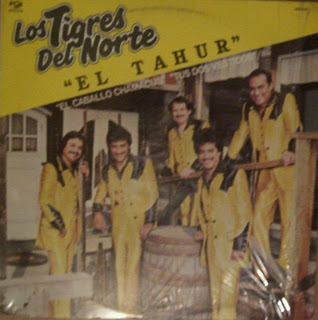
Los Tigres del Norte: El Tahur, 1986


This album comes from Los Tigres' arguably least remembered period following their break into stardom with Contrabando y Traición. Chalino Sanchez had not yet transformed the narcocorrido into the international sensation that it has become. I firmly believe that although Los Tigres were the first to popularize the genre on a large scale, they would not be the superstars they are today without Chalino's help bringing the genre to the Chicano audience. This record contains both corridos and dance songs, and the title track is a ballad about a fair, honest, and respected gambler who one day falls on bad luck and loses everything. When he gets a good hand and feels he can't lose, he bets his wife out of desperation. When his opponent shows four aces, he becomes distraught and takes his own life along with that of his wife to spare them both the pain of his mistake.

El Tahur was written by Adolfo Salas, who as far as I can tell was one of the songwriters who Los Tigres contracted writing responsibilities out to. The song is very unusual in the sense that its protagonist owes his downfall more to fate than social injustice. In this regard, it is different from all other narcocorridos and classic corridos that I have heard. I should go further into the significance of this before I discuss the song. My explanations of two primary subjects in corridos, misfortune and morality, both start in the same place, the divide between what is called la plebada and the elite, or "educated" class, made up of politicians and licenciados, or degree holders. Many see the elite as encompassing American business interests as well. La plebada is a term that roughly correlates to "the people" or the "popular class," a class of people disenfranchised and/ or marginalized in one way or another for one reason or another. In Mexico, la plebada by this definion makes up a large majority of the population.

According to narcocorridos, all cartel members originate in la plebada, even if the drug business eventually makes them rich. Narcocorridos portray the elites as the cumulative holders of legitimate power and the controllers of legitimate industry. The songs allege that these people have no interest in sharing access to economic mobility with la plebada. They blame members of the elite for the actions of cartels, alleging that if poor people had the opportunity to make money through legitimate channels, they would not need to turn to illicit activity. Many narcocorridos also include premonitions of an early death for their protagonists. The idea is that by entering the business, they trade wealth for longevity. In this sense, the elites have sealed the narco's fate from birth: he could follow the law and barely scrape by or try to make something for himself by risking his life. The moral argument that follows is obvious: saying that narcos choose to enter the drug industry might be something of an overstatement, (although some songs do attribute a genuine enthusiasm for violence to their protagonists,) because while violence might be a preferable option to starvation, it is not an easy living compared to that of a politician. Along these lines, narcocorridos portray la plebada as honest and the elites as dishonest. A quick explanation is that the elites rely on twisted language to maintain their power whereas the people are more given to hard work and have no use for dishonesty among themselves. In many narcocorridos, honesty has become a class marker. Narcos who break the laws and mores of the rich do so because this code fundamentally disenfranchises the people. Classic corridos are a little bit different, but the essential facts are the same. The heroes come from the lower class and struggle against powerful outsiders, both Americans and Mexico City elites, but value hard work and honesty among their own people. The main difference is the degree of the protagonists' antiauthoritarianism.

As I say above, fate rather than social injustice led to el tahur's downfall. Given the stigma against heavy gambling in our society, some readers might fully fault the gambler for his loss. However, I believe that Los Tigres intentionally leave the responsibility for the gambler's misfortune ambiguous. Of course, the gambler is at least somewhat accountable because he chose the gambling lifestyle in the first place. The only hint of class identity comes at the beginning of the song when the narrator describes the gambler as "unfailingly honest, a man who knew how to win and lose," i.e. how to take his losses in stride because he was fully aware of the risks he took. As an honest member of la plebada, he would not cheat another member of his own class. Even with his final defeat, the gambler did not try to cheat his opponent out of his winnings by skipping town with his wife and starting over elsewhere. Although he did deprive his opponent of the spoils by killing his wife, the gesture of suicide also indicates that he took responsibility for his actions. To the end, he remained an honest plebe, respecting his gambler's code even after it ruined him. By this logic, he committed no social wrongs and thus did not deserve his sad end in a karmic sense; at most, he was guilty of mismanaging his personal affairs.

This is the extent to which the gambler is responsible for his downfall, but there is still enough blame left over that some of it can be pinned on fate. In order for the gambler to lose his wife, three events had to converge in a single moment. First, the gambler had to lose all his material possessions, so that the only thing he had left in the world was his wife. Second, he had to pick up a hand so strong that there was no doubt in his mind that he would win with it. The song implies that his hand made him so confident that he did not even consider the possibility of losing. Finally, his opponent had to get a nearly unbeatable hand at the same time. The setup was such that any desperate person, even one with no inclination for gambling, could have accepted the nearly negligible risk in order to win some semblance of his life back. By this reading of the story, it was not a rational gambler who lost his wife, but a desperate man. The gambler was guilty of losing almost everything, but fate took his wife from him. What is clear is that whether fate or the gambler is to blame, the rich have nothing to do with the gambler's demise. I consider this song something of an anti-corrido because in the end, it leaves us without a moralistic commentary about class and without a clear moral. Maybe the author means to warn us that fate can strike us when we are most vulnerable. In this sense, this song might not be so far removed from the narcocorrido after all: if the gambler stands in for la plebada by analogy, then even though he played by the rules all along, he ended up with nothing. At the end of the day, he is left with his wife, (read: "life,") to wager, and indeed, when push comes to shove, he is gambling with his own life, much like the narco who risks his life to escape poverty. Maybe I've gone too far looking for meaning where it doesn't exist with this last parallel, but in any case, the very role of fate in this corrido sets it apart.

Wednesday, September 21, 2011

John Holt: Police in Helicopter/ Youths Pon the Corner, 1983/ Un saludo a la dea


Great reggae. The production is really clean on this single, but you can hear fire in John Holt's voice. On the A side, John Holt threatens that if the police continue to burn down marijuana fields, smokers will retaliate by burning down plantation cash crops. It seems like drug enforcement offends Holt on two levels, both because it is yet another form of oppression and structural violence against the poor (listen to the B side for more of this) and because it is a cultural battle with religious dimensions. When Rastafarianism pushes back against Western hegemony, the religion itself comes under attack (via the sacrament marijuana) along with the people who practice it. Youths Pon the Corner is a version that didn't appear on the Police in Helicopter LP.

The idea of burning down the corn fields to get back at the powerful for destroying marijuana crops calls to mind certain themes in some modern day narcocorridos. First, like John Holt, a lot of musicians who sing of the Mexican drug war don't try to hide their contempt for governments. The reliance on drugs, both economic and spiritual, by protagonists in narcocorridos and in Holt's song automatically casts them as opponents of governments that aim to eradicate the manufacture and consumption of certain drugs. John Holt and the corridistas both see drugs as part of the fight against what rastas call Babylon and traficantes call la calaca, but for the rastas, the marijuana they smoke is something they choose for religious enhancement. Cartels chose drugs because their prohibited status makes them valuable and, according to some singers, because narcos were born to pursue wealth in the most anti-authoritarian way they could. Second, the opposition that Holt sets up between rastafarianism and conventional capitalism (represented by corn farming) gives the struggle a classed dimension as the rich and economically entrenched wage a cultural war against the poor on the basis that the rastafarian religion's acceptance of marijuana is a sign of immorality. Holt counters that because rastas do not interfere with capitalists' pursuit of wealth, capitalists should not interfere with rastafarians' pursuit of spiritual fulfillment. Narcocorridos maintain that their protagonists grew up poor and joined the cartels because they could not make enough money any other way. Many singers argue that legitimate business is a luxury possible only for the already established upper class. Furthermore, the elite class bear most of the guilt for drug violence because its members have systematically excluded poor people from legitimate sources of wealth through nepotism, corruption, and class-based discrimination.

In an open letter to the U.S. government by a panel made up of Kofi Annan, Ernesto Zedillo (ex-president of Mexico), Cesar Gaviria (ex-president of Colombia), and others encouraged Obama to end "the criminalization, marginalization and stigmatization of people who use drugs but do no harm to others." Speaking about the panel's findings, Gaviria said "when you have 40 years of a policy that is not bringing results, you have to ask if it's time to change it." For more information: http://articles.latimes.com/2011/jun/01/world/la-fg-mexico-drug-policy-20110602 Other Mexican and American critics of current drug enforcement policies actually advocate legalizing or decriminalizing drugs in the U.S. because without American demand for a contraband product, cartels would be economically crippled. Whatever specific approach the governments of the United States and Mexico take in response to the tragic violence in Mexico, I hope that they take Gaviria's advice to heart. A series of militaristic offensives against drug organizations will only encourage militaristic responses, and this hemisphere is already plenty militarized. In spite of what some songs might tell you about men who are born for blood, most people join cartels because no other organization offers a comparable opportunity, and that opportunity owes itself to a high demand for illegal drugs in the United States. If the leaders of these countries want to get serious about addressing the drug war as a matter of damage control rather than elitist morality, they will have to come to terms with the economic realities of the war in one way or another. I'm sure John Holt would agree.

Youths Pon the Corner by Easy Jams

Tuesday, September 13, 2011

El Chicano: Viva Tirado Parts I and II, 1970


El Chicano has recorded a couple versions of this song, including one on the album Celebration and another as the title track of a 1970 LP. The A side of this 45 is the same version that appears on the album Viva Tirado, and the B side is an extended version that sounds like it was recorded during the same sessions. El Chicano's choice of Viva Tirado as something of a signature song caught my attention in light of the song's history. The song was originally written by Gerald Wilson, the great LA big band leader whose record On Stage I posted last year. At a time when many jazz musicians were looking to musics of the Spanish Caribbean for inspiration, Gerald Wilson was more taken with the music and culture of Mexico, which he came into contact with once he moved to California. Although Wilson's musical nods to Mexico might sound less than authentic to those versed in different kinds of Mexican music, one cannot deny that Wilson's Mexican-esque compositions are, if nothing else, genuine expressions of his admiration for the Mexican people and their culture. At a time when few people of Mexican descent had broken into the jazz world, his band featured Mexican-American musicians like the great Anthony Ortega, and for most of his life, Wilson has been married to a Chicana woman. Throughout his career, the bridging of cultural boundaries through art has been a major if understated theme in Wilson's work.

Turning now to El Chicano, their use of this song strikes me as part of an effort to reciprocate the kind of admiration that jazz artists and other Black musicians like Wilson have paid to Mexican and Chicano artists over the years. I say this not only in terms of this song's particular history, but in terms of El Chicano's 1970's catalog in general. Most of the band's albums feature songs that walk the line between jazz, soul, salsa, and rock. El Chicano seem to have been acutely aware of the different streams of music going on at the time and of the ways in which these musics intertwined with various cultures and subcultures. The different genres of music that El Chicano nod to make up the musical and social world that they were playing in at that time. Though salsa came to the U.S. by way of immigrants from the Caribbean, it nonetheless became popular as a Latin music for all Spanish speaking people in the United States, including a Chicano population who at that time largely saw Mexican musics like norteña music as unurban, less a part of their life experiences which defied characterization as completely Mexican nor American. The rock that El Chicano played both indicates a proximity to mainstream American society, (they have covered songs like Brown Eyed Girl,) and the Chicano rock bands that made up a significant part of the East L.A. art renaissance of the 60's and 70's. Their use of soul and jazz recalls Wilson's use of Mexican themes as an attempt to bridge the cultural gaps between minorities in America though music.

To me, this project looks like an optimistic outgrowth of the Black and Chicano movements going on at the time. The fusion of these musics can be read as a part of a new multicultural urbanism that is equally constituted by its component parts and also distinctly American. And yet the ablums that I have heard from El Chicano do not feature lyrics or liner notes promoting racial harmony or anything like that. Whereas many musicians today who take inspiration from a diversity of cultural forms tend to be very explicit about the importance colorblind acceptance and love, El Chicano seem to promote a new American multiracial idiom by performing it, treating it as natural rather than a goal that society must pursue. This is what I mean when I call their project optimistic: they don't treat their vision of the new American melting pot as utopian, but rather as something closer to reality. In this sense, this 45 is a small piece of a very interesting body of work that responds confidently to a unique time in American racial history.

Viva Tirado Part II by Easy Jams

Wednesday, September 7, 2011

Charles Mingus: Jazz and Cumbia Fusion, 1978


I usually try to avoid posting albums that are up on other blogs, but this one seemed so relevant to the last two posts that I wanted to say something about it too. First of all, the album itself is great, not one of my favorite Mingus albums, but a fun listen. It opens up with bird songs that slowly drop out as percussion instruments enter. That intro reminds me a lot of the first Accra Trane Station track on Steve Feld's Time of Bells 3 album, (couldn't find it on youtube, sorry;) it's jazz but the producer has a very present role. From there, the sound becomes more recognizably Mingus, but a lot of the first side in particular revolves around a couple cumbia-esque riffs. To me, the "cumbia" on this disc doesn't even really sound all that convincing. I see it more as a jazz interpretation of cumbia than a genuine attempt to create a hybrid music with strong roots in both genres.

The thing that stuck out to me about this album is Mingus's attempt to reach out to a music whose roots in the Black diaspora are well known but which does not have much of a history within jazz. Mingus's fusion attempt was different from Mustafa-Zadeh's work because Mingus was not a foreign musician trying to force his music into jazz from the outside. Like Mustafa-Zadeh, though, he was not drawing on a long history of cross cultural jazz hybrids either, so the composition process must have taken a fair amount of creativity and mold-breaking on his part. But overall, it seems like the inclusion of cumbia on this record was more of a way to freshen things up than to take a deep look at cumbia forms. This partial embrace of cumbia fits a theme that I've noticed in a lot of Mingus's music: he hints at or acknowledges a variety of genres (typically blues and subgenres of jazz) but ultimately adapts them all to fit his own artistic vision. In that sense, despite the uncharacteristic inclusion of a Latin American influence, this record is actually fairly conventional for Mingus.

Jazz and Cumbia Fusion by Easy Jams

Wednesday, August 31, 2011

Vagif Mustafa-Zadeh: Aspiration, 1978


Continuing on the topic of foreign influences in jazz music, here's Aspiration by Vagif Mustafa-Zadeh, the great pianist from Azerbaijan. The album consists of straight ahead jazz songs by a trio, adaptations of Azerbaijani folk songs featuring singing by Elza, Vagif's wife, and a very interesting title track that fuses jazz with the mugamat, or scales, common to Azerbaijani music and other Middle Eastern musical traditions. Mustafa-Zadeh plays the song in the tempered tuning standard to Western music rather than the uneven tuning of the mugam, but to me, this song nonetheless feels deeply rooted in another musical idiom. Hear an example of an Azerbaijani mugam here, played on a lute instrument called the tar by Bahram Mansurov: http://www.youtube.com/watch?feature=player_profilepage&v=JsSoLQobKsc. Clearly, with this song and other work in the same vein, Mustafa-Zadeh created a modernized hybrid music out of jazz and his country's musical tradition, not to mention causing a stir among the Soviets for playing American jazz in the early days of his career.

What I really want to talk about today is how unlike musicians from other countries whose musical backgrounds were gladly accepted into the cannon of American jazz, musicians from other parts of the world have had to force jazz to adapt to their regional music. That is not to say that some musicians, like Ahmed Abdul-Malik, have not expressed an interest in Middle Eastern and North African musics, and Joe Harriott's Indo Jazz Fusion work with John Mayer also paved the way for many hybrid musics to come. What's more, many musicians from Middle Eastern, North African, and South Asian backgrounds are highly regarded in jazz today. But because the musics from these places tends to lack an obvious connection to the diasporic musics of Black Africa, they have not been received as readily as Brazilian or Cuban music by most American jazz musicians. Jazz is an incredibly international music, and a lot of work has been done individually and collectively by jazz musicians to bring a variety of influences into the music. In some instances, like the Brazilian case, whole movements have occurred in which Americans and musicians from abroad have worked together and separately to develop these hybridizations. Both musicians and records played the role of jazz ambassadors. What fascinates me about music like Mustafa-Zadeh's is that people in his position have to work very much on their own compared to jazz musicians playing sambas and other musics of the Black diaspora well established within the jazz cannon.

George Lipsitz has said that the very project of establishing a conventional jazz cannon, a project undertaken by people like Wynton Marsalis, has forced the exclusion of many musicians from what is conventionally considered jazz even though those musicians see their music as a contribution to jazz. I think that Mustafa-Zadeh and others like him have had to cut out a place for themselves in the jazz world for another reason. While it might not have helped that elite circles in jazz lacked interest in their music and even saw it as less pure than other jazz, they were also largely off the radar of most jazz musicians in general, even those who discontent with the Marsalis model of jazz. Some musicians simply come from marginal corners of the jazz world, and like I say, because they have a fewer predecessors to look to in fusing their music with jazz, they must come up with creative ways to integrate two disparate musics into a coherent whole. Even if their songs and performances aren't always remembered as timeless classics, they are true mavericks of jazz.

Mustafah-Zadeh passed away in 1979. His daughter Aziza Mustafa Zadeh has continued along the path the he cut, singing and playing jazz-mugam hybrids on the piano. Nowadays, an increasing number of musicians have been integrating many musics historically unfamiliar to the jazz cannon into jazz contexts. I'm personally very excited to see Rudresh Mahanthappa, one of today's most widely renowned Indian-jazz hybrid artists, play at the Angel City Jazz Fest in Los Angeles this fall.

Vagif Mustafa-Zadeh: piano
Tamaz Kurashvili: bass
Vladimir Boldyrev: drums
Elza Mustafa-Zadeh: vocals

Aspiration by Easy Jams